
Commercial Health Plans: Oncology Medication Management and Market Access
Highlights of the report:
Download a PDF of these Highlights
As oncology innovation accelerates, commercial health plans are building increasingly sophisticated strategies to manage access, utilization, and affordability. HIRC's report, Commercial Health Plans: Oncology Medication Management and Market Access, reviews plans' approaches to oncology management and examines the resulting market access landscape. The report addresses the following questions:
- What key oncology-related market trends are commercial health plans currently monitoring?
- What is the status of payers' utilization management tactics across oncology medication types (e.g., targeted therapies, checkpoint inhibitors, biosimilars, CAR-T)?
- What is the status of oncology preferred drug lists (PDLs), exclusion lists, and clinical pathway adoption across cancer types?
- How are plans managing oncology medication distribution (e.g., preferred specialty pharmacy, white bagging, site of care management)?
Key Finding: In response to the rapidly growing market of oncology medications, plans are expanding their oncology management toolkit–from site-of-care optimization and biosimilar adoption to tighter utilization management, preferred products, and clinical pathways.
Oncology Cost Growth Emerges as Plans' Top Market Concern. Commercial health plan decision-makers were asked to identify the top oncology-related market trends impacting their business. Overall, rising oncology costs—including pipeline expansion, cell and gene therapies, and high launch prices—remain the dominant concern across commercial health plans, while growing biosimilar adoption is emerging as one of the primary strategies for managing these cost pressures.
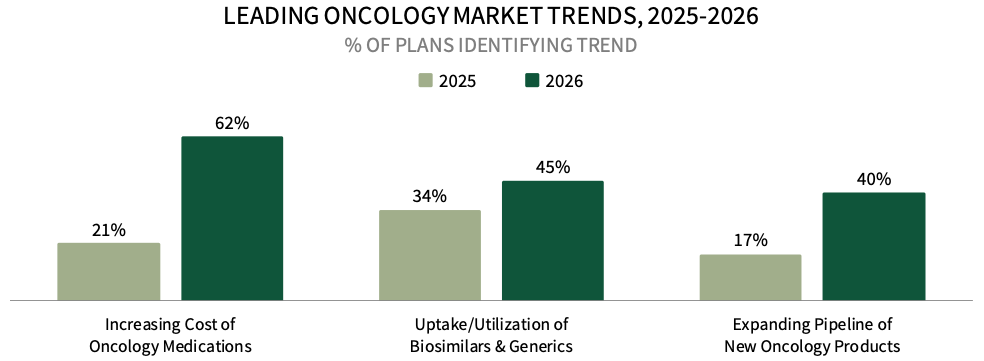
The complete report examines a detailed listing of 23 market trends identified by health plan leadership.
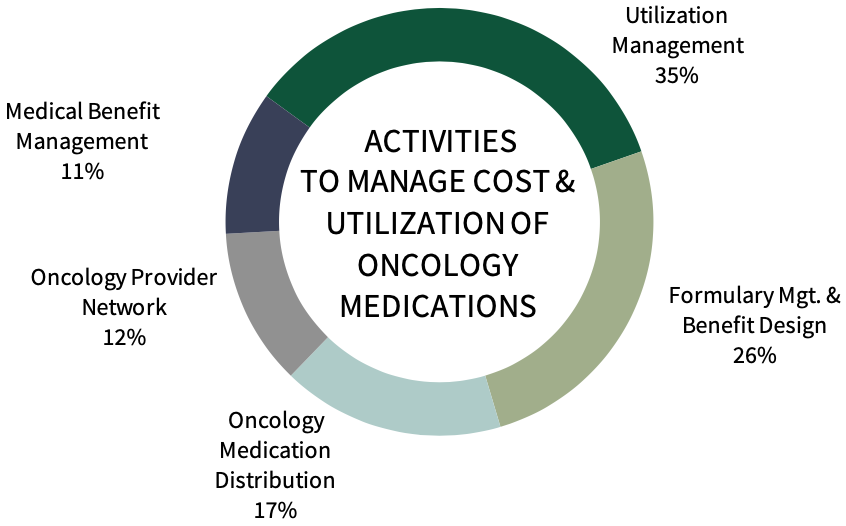
Utilization and Formulary Controls Dominate Near-Term Management Priorities. Commercial health plans are focused primarily on two things over the next 12–18 months: tighter utilization management and stricter formulary control. Together, these account for 61% of all planned activities, followed by medication distribution (17%), provider network (12%), and medical benefit initiatives (11%). The complete report examines 22 activities that plans are pursuing to manage oncology medication cost and utilization.
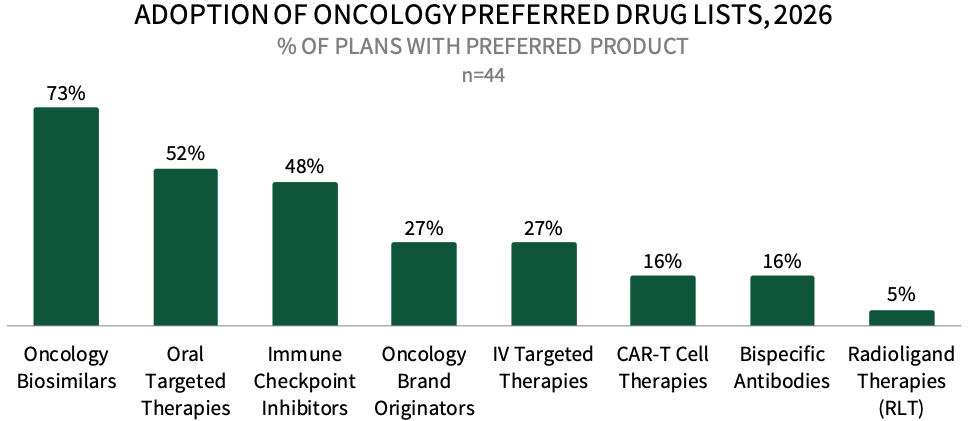
Biosimilars Are the Most Widely Preferred Product Type. Oncology biosimilars are the most widely preferred oncology medication type, with 73% of commercial health plans designating at least one product as preferred. Product preference is also relatively common for oral targeted therapies (52%) and immune checkpoint inhibitors (48%) but remains less established across newer and more specialized treatment categories. The complete report evaluates preferred oral and IV oncology medications across 19 cancer types.
Research Methodology and Report Availability. In June 2026, HIRC surveyed 44 pharmacy and medical directors representing national, regional, and BCBS plans covering 87 million commercial lives. Findings were gathered through online surveys and follow-up telephone interviews. The complete report, Commercial Health Plans: Oncology Medication Management and Market Access, is available now to HIRC’s Managed Oncology subscribers at www.hirc.com.
Download a PDF of these Highlights
Download Full Report (Subscribers only) >